
Helping children go back to school after lockdown: Part 1

Over recent weeks TRM Academy has been approached by foster carers, parents, youth workers and social workers for advice in helping children transition back to school after the coronavirus lockdown.
Whilst we are able to deliver training to agencies we thought it would also be helpful to provide some freely available suggestions that may make this process easier.
Dr Tricia Skuse
Consultant Child & Adolescent Clinical Psychologist, TRM Academy
Who is this guide for?
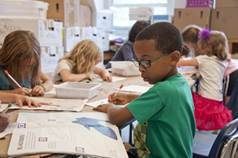
This guide is aimed at parents, foster carers, social workers, teachers, youth workers and anyone else working with children who are soon to make the move back into education.
Not all strategies will work for all children. Experiment and see which ones help. You also know your child - you will soon be able to see which ones fit. Most of the strategies should be useable with both the younger age group and the Year 6 children. If there are particular consideration for certain ages groups this has been indicated.
Constant change
The coronavirus has produced many challenges. A key one for most of us has been the constantly changing set of circumstances we are having to make sense of and respond to.
There was lots of uncertainty at the beginning of the year as to whether the virus would hit us, then an increasing level of understanding that it was coming our way and we better prepare ourselves for it. Then there was the concern about when
schools would close and when would the nation go into lockdown. Next came the period of adjusting to lockdown and what that entailed for our families and loved one. For some this was a time of anxiety and panic, for others it was accompanied
by a greater sense of community and pulling together.
During the last couple of months of lockdown, some people have gone through the most horrendous hardships - loss of loved ones, loss of contact, loss of jobs, financial difficulties etc. Others, have been muddling along with home-schooling, trying to work from home and stick to the government guidelines. Many families have experienced it as an opportunity to pause, spend time with their immediate family and enjoy being together.
In sum, throughout the majority of this year, it has been a process of constant change. Each little stage has only lasted a few weeks before circumstances or information changes and we have to adjust again.
And now, we have entered another phase: Coming out of lockdown. It will inevitably be a protracted period of uncertainty, worry, confusion and even dread. This is not helped by the fact that different nations of the UK are easing
restrictions at different times, in different ways and at a different pace. As I write, in England the plan is for shops to open in a couple of weeks, whilst in Wales people are still only allowed out of their homes for exercise, essential
work and shopping.
An area which has created much anxiety is the process of returning children to school. Again, there are national variations. What does seem likely is that children in Reception or Years 1 and 6 will be the first to return to school. There has been much discussion and media coverage about the safety and value of returning children to school, which has added to the level of anxiety about the process.
Whilst the debate rumbles on, parents, foster carers, and residential staff are left wondering how best to prepare children for the transition back to school. Uncertainty causes anxiety - the trick is to move to a position where the uncertainty feels more manageable and as safe as possible.
| Download all | In the Part 2 of this guide, Tricia explores anxiety in children returning to school... | Part 2 Part 3 |